Recap: “Borders in the Ocean: Identity and Otherness in the Italian Navy Ocean Diaries”
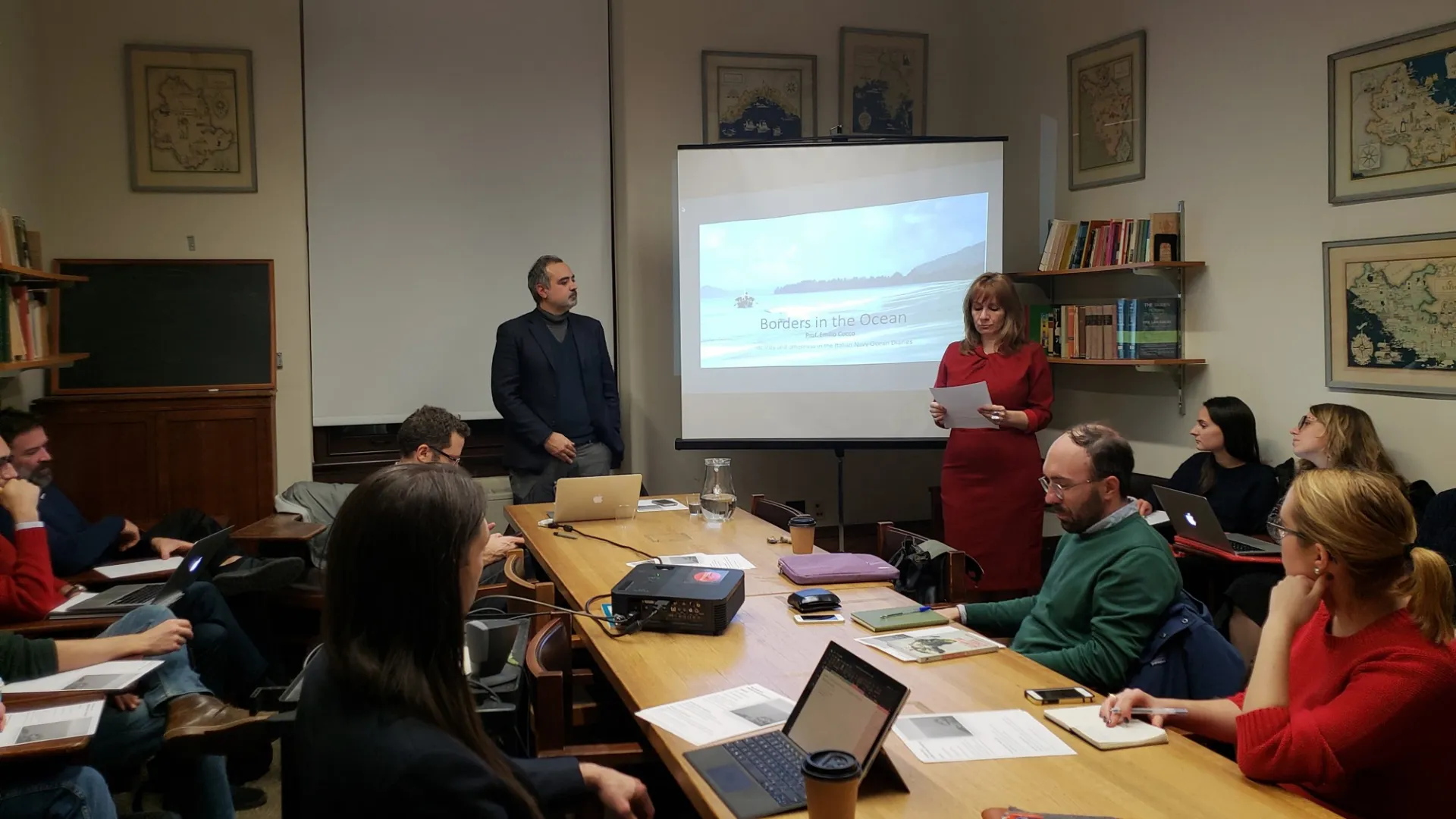
Last night, we had another opportunity to dive into some underexplored aspects of Italy’s history at the next event in The Italian and Mediterranean Colloquium series. The event, “Borders in the Ocean: Identity and Otherness in the Italian Navy Ocean Diaries,” featured Emilio Cocco (Università degli studi di Teramo, Italy-American University of Rome), co-author of I confini nel mare (2016). We were also able to hear from Naor Ben-Yehoyada (Columbia University) and Konstantina Zanou (Columbia University) as they posed new possibilities for study on this topic and made further connections between Cocco’s research and the historical context of 19th c. Italians at sea in a national Navy. In his talk, Cocco focused on the sociological impact of the ocean and global competition at sea on the culture of the Italian Navy and, ultimately, on the formation of Italian nationhood.
Also included in this process of building the Italian imagined community, according to Cocco, was the "othering" of people from distant nations. On this subject, Cocco read from the historic journals of Italian Naval officers; these officials were some of the first Italians to start doing distinctly national naval missions in far-off countries. Cocco also explained that one of the main purposes of the Italian Navy at the time was to branch out of the Mediterranean sphere into a global seafaring environment. Thus, Italians in the Navy were frequently a long way from home and saw people who looked and acted differently from themselves as a result. Some examples of places visited by the Italian Navy in the 19th c. include Tahiti, Tierra del Fuego, and many countries in Africa.
For the Italians, seeing these new people abroad was both fascinating and somewhat disturbing, which is comparable to responses of many other European societies at the time who also ventured away from their home continent. An example of this contradictory sort of mentality is that Italian Naval officers would write almost nostalgically about the native populations of the far-off lands, comparing those people to the ancient Romans. However, after reflecting on the similarities the officers saw between the foreign populations and their own ancestors, the same officers would proceed to criticize the natives, saying that the native populations, as Cocco paraphrased, “cannot be civilized.”
Overall, these interactions, while building Italians’ perceptions of various types of people abroad also constructed a sense of Italian whiteness. That is, Italians began to distinguish themselves as white and their others as darker, or black-skinned people.
These were just some of the main ideas from the event, but Cocco, Ben-Yehoyada, and Zanou brought up many other intriguing points throughout about the nature of 19th c. Italians’ perceptions of their own nation compared to their concept of the "other" abroad.
The December 6, 2018 session of the Italian and Mediterranean Colloquium was sponsored by the Department of Italian, the European Institute, the Institute for Social and Economic Research and Policy (ISERP), and the Department of Anthropology. More details about the colloquium, along with future events, can be found on the Italian and Mediterranean Colloquium page.