“Politics Is Dating”: A Conversation with Giuliano Amato on Democracy and the Future of the European Project
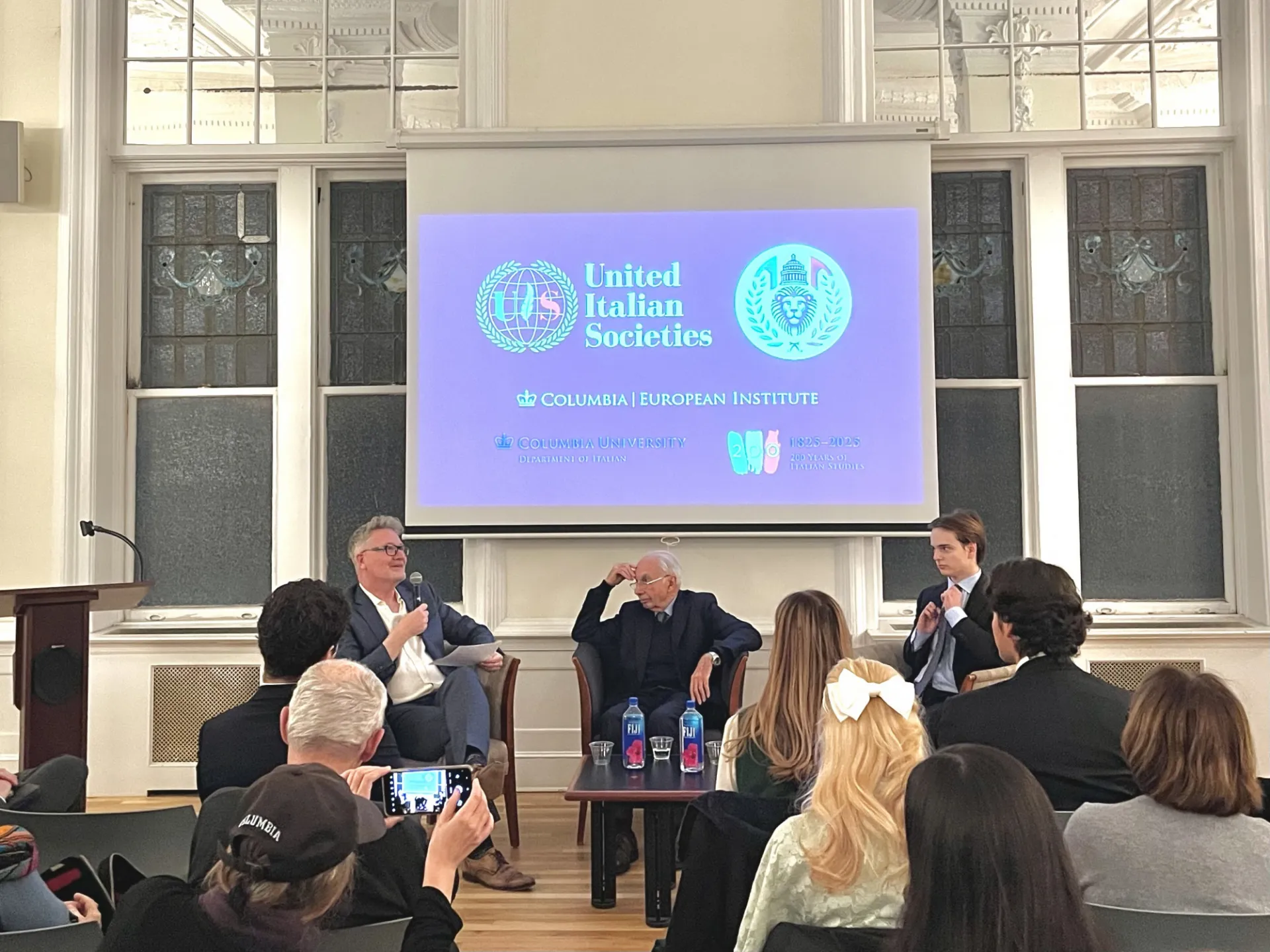
On November 17th, the European Institute, Department of Italian, the US Chapter of United Italian Societies, and the Columbia University Italian Society, welcomed Giuliano Amato, former Prime Minister of Italy and President Emeritus of the Italian Constitutional Court, to Columbia University for a conversation on the evolution and future of democracy in Europe.
Professor Elizabeth V. Leake, Chair of the Department of Italian, opened the event, noting the significance of hosting Amato during the celebration of 200 years of Italian at Columbia University. The discussion was moderated by Professor Adam Tooze, Director of the European Institute, together with Giulio Maria Bianco, a Columbia SIPA student.
Amato began by recalling the origins of the European Union as a postwar response to conflict, grounded in shared constitutional principles, human rights, and a collective commitment to ensure that war would never again define Europe’s future. Over time, legal institutions, market integration, and eventually a shared currency reinforced this foundation, allowing citizens to experience Europe as both a political success and as a tangible legal and economic system.
The conversation then shifted to the challenges the European Union has faced in recent years, including widening inequality, delocalization, and polarized politics. When the original material benefits of the EU, such as economic opportunity and labor mobility, weakened for large portions of the population, values alone were no longer sufficient to sustain confidence in the European project. Events such as the rejection of the European constitution and Brexit emerged from this shift in sentiment, even if the aftermath of Brexit discouraged further exits.
Looking to the future of the EU, the conversation centered on the need to counter polarization, rebuild trust, and renew civic participation as essential components of democratic resilience. Political life has increasingly shifted toward reactive, screen-mediated exchanges that weaken social cohesion and reduce opportunities for local and national-level deliberation. Traditional political parties have also faded as mediating institutions capable of translating public needs into shared political projects. In this context, James S. Fishkin’s work on deliberative polling was referenced, which demonstrates that citizens’ views often evolve when they engage in structured dialogue rather than relying on isolated voting or passive consumption of information. The conversation emphasized that democratic culture must be strengthened at the local level, recognizing that voting is only one stage in a longer process of public reasoning, responsibility, and shared imagination. Ultimately, the reminder, as Amato remarked, that “politics is dating” highlighted the importance of face-to-face encounters, human connection, and mutual persuasion as critical to moving away from polarized and transactional practices and renewing European democratic life.