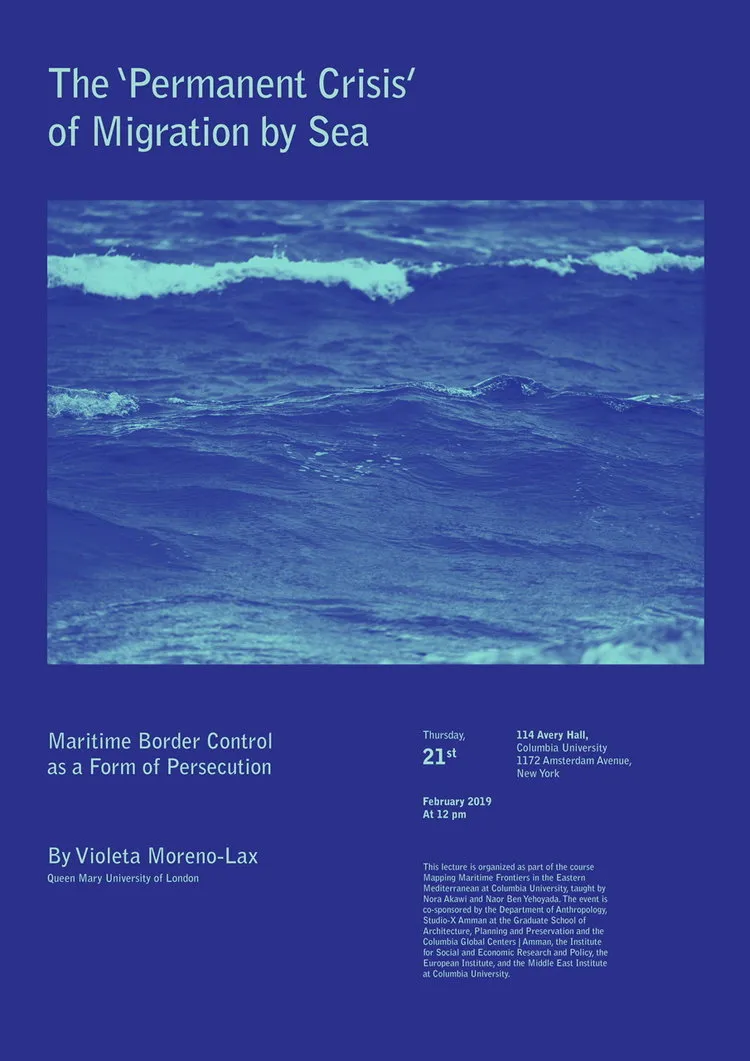
On February 21, 2019, the European Institute co-hosted Dr. Violeta Moreno-Lax for a lecture on the European Union institutions’ and member states’ methods in deterring irregular migration in the Mediterranean.
In her talk, Dr. Moreno-Lax argued that the media and policy narrative of a “permanent crisis” has allowed the gradual militarization of European border control practices. These changes have happened without investing adequate resources to ensure the protection of the fundamental human rights of refugees and migrants.
She also maintained that the EU’s border control regime is characterized by increased extraterritoriality. Indeed, EU border management takes place not only at the borders of its member states, but also through supporting the border enforcement of its partners. According to various sources, the Libyan authorities, who benefit from direct support from the EU and its member states, have committed numerous human rights violations.
Dr. Moreno-Lax currently acts as the lead counsel in an application against Italy at the European Court of Human Rights. On November 6, 2017, at least 20 people died, as the Libyan Coastal Guard interfered with a German NGO’s attempt to rescue people from a capsized boat. The intervention was coordinated by Italian Maritime Rescue and Coordination Centre and Italy’s Mare Sicuro mission. For these reasons, the seventeen survivors of the incident argue that Italy acted in breach of the European Convention on Human Rights.
From these perspectives, Dr. Moreno-Lax argued that the increase in extraterritorial and military practices that seek to deter migrants may amount to persecution. The EU itself defines persecution as “the severe violation of basic human rights by nature or repetition” (Art. 9 EU Directive 2011/95).
Dr Violeta Moreno-Lax is Senior Lecturer in Law, founding Director of the Immigration Law programme, and inaugural Co-Director (2014-16) and co-founder of the Centre for European and International Legal Affairs (CEILA) at Queen Mary University of London. She is also Visiting Professor at the College of Europe, Fellow at the Centre of European Law of King’s College London, EU Asylum Law Coordinator at the Refugee Law Initiative of the University of London, Co-Chair of The Refugee Law Observatory, Co-convener of the Society of Legal Scholars (SLS) Migration Law Section, as well as member of the Steering Committee of the Migration Law Network.
The lecture was organized as part of the course Mapping Maritime Frontiers in the Eastern Mediterranean at Columbia University, taught by Nora Akawi and Naor Ben-Yehoyada. It was co-sponsored by the Department of Anthropology, Studio-X Amman at the Graduate School of Architecture, Planning and Preservation and the Columbia Global Centers | Amman, the Institute for Social and Economic Research and Policy, the European Institute, and the Middle East Institute at Columbia University.